
Exiles and the Idea of Home
The SympathizerThis flow follows the shifting meaning of home from Saigon to American refugee life and back to a Vietnam the narrator can no longer safely inhabit.
increasing Bearing strength in each event
 decreasing
Bearing strength in each eventdecreasingLeaving Saigon

Leaving Saigon
A City in Fragments
The narrator watches familiar streets, cafés, and religious landmarks pass as the evacuation convoy winds through the city. He sees a home filled with beauty, poverty, and political violence.
Departure Without Closure
Bon asks whether they will ever see the streets again. The narrator says they must believe they will, though he knows his assignment may keep him away for years.
Leaving is both escape from an imminent defeat and a separation from the places that have shaped the narrator’s language and memory.
A Camp Without a Country
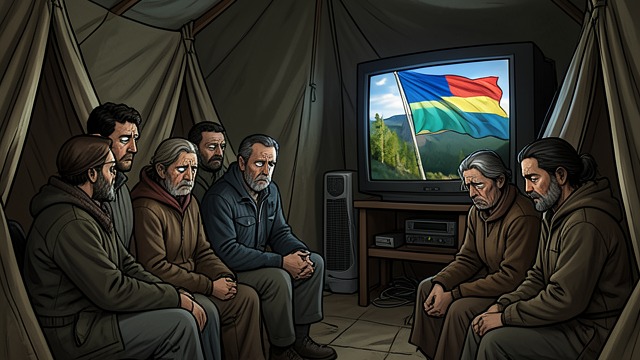
A Camp Without a Country
A Nation Seen on Television
The refugees watch images of Saigon’s fall and the new government’s flag being raised. The General’s family and the narrator are physically safe but cannot understand themselves as ordinary immigrants.
Grief in Temporary Space
Refugees live in barracks and tents while mourning the loss of their country and relatives. The narrator writes to Man through a Parisian aunt, carrying two homelands in one coded letter.
The camp makes home a political absence that cannot be replaced by shelter alone.
A Foreign Home

A Foreign Home
Material Comfort
The narrator notices that even poor Americans have refrigerators, running water, and electricity. Those conveniences do not prevent him from feeling poor and displaced.
Assimilation’s Unequal Terms
He works in an academic department where others treat him as a cultural specimen, while Bon struggles with grief and unemployment. The exiles learn American routines without feeling fully accepted as Americans.
The American Dream promises opportunity, but its emotional price includes dispersal, racialization, and the pressure to become legible to people who still see foreigners.
The Clock on Saigon Time

The Clock on Saigon Time
Two Time Zones
The narrator notices a clock shaped like Vietnam and learns that it is set to Saigon time. The object displays the exiles’ wish to remain attached to a place far away.
Circles Instead of Return
He reflects that displaced people live in the present and the past at once. The distance home may be finite, but the years before a possible return seem endless.
The clock makes exile a temporal condition: memory does not simply look backward but repeatedly reorganizes the present around an imagined return.
Home as a Dangerous Choice

Home as a Dangerous Choice
Return and Rejection
After escaping the camp, the narrator and Bon return to Saigon, where revolutionary rule limits speech and music. They are home geographically but cannot regain their old place in society.
Another Departure
They prepare to leave by boat, accepting the risk of death rather than remaining in a country that will not grant them an ordinary life. Their manuscript goes with them as a record of what they have lived.
Home becomes neither a simple destination nor a guarantee of belonging; survival requires leaving it once more.
April 1975, during the airport evacuation
After the family arrives at Camp Asan
During the narrator’s first years in Los Angeles
After Madame and the General open their restaurant
Near the ending, before the planned sea departure
